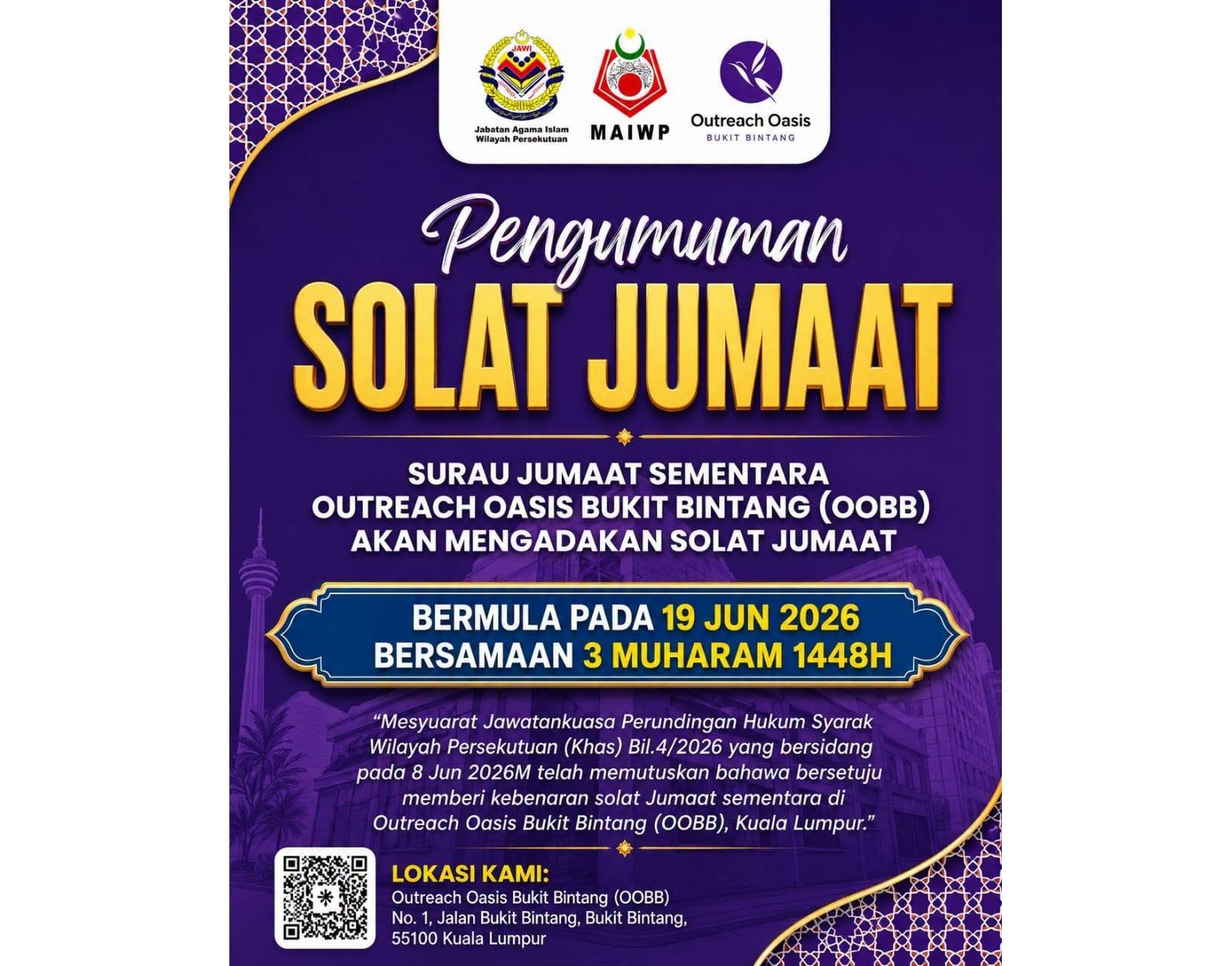
Muslims in the heart of Kuala Lumpur's bustling Bukit Bintang district will now have a dedicated venue to perform their Friday prayers, with the opening of a temporary facility at the Bukit Bintang Outreach Oasis commencing June 19. The initiative follows special approval from the government and represents an important step towards accommodating the religious needs of both residents and the floating population who spend their weekdays in this major commercial and tourism hub.
Dr. Zulkifli Hassan, the Minister in the Prime Minister's Department (Religious Affairs), announced the development through a Facebook statement, emphasizing that the temporary arrangement will remain in place until a purpose-built Friday surau can be completed at the location. His announcement comes at a significant moment for the Muslim community in Bukit Bintang, where the absence of convenient prayer facilities has long posed a practical challenge for those seeking to fulfil their religious obligations during the working week.
The opening of this temporary prayer space addresses a genuine gap in Kuala Lumpur's infrastructure. Bukit Bintang, as one of the country's premier shopping, dining, and entertainment destinations, attracts hundreds of thousands of visitors monthly, many of whom are Muslim workers and shoppers. Previously, those wishing to perform Friday prayers in the area faced the inconvenience of travelling considerable distances or navigating crowded public spaces to find suitable prayer facilities. The new arrangement eliminates this burden and demonstrates the government's responsiveness to the practical needs of urban Muslim communities.
The temporary facility is positioned as a holding measure while authorities undertake the construction of a permanent, dedicated surau at the site. This staged approach reflects both budgetary and logistical realities in urban development, yet it does not diminish the immediate benefit to the community. Many Malaysian cities have adopted similar interim solutions when establishing new religious infrastructure, and the arrangement at Bukit Bintang aligns with best practices seen in other developed urban centres across the region.
Dr. Zulkifli's statement carried a tone of celebration, with his reference to history being made in Bukit Bintang reflecting the significance he attaches to this development. His invitation to the community to participate in the Friday prayers carries an implicit message about the collective responsibility of Muslims to support and strengthen religious observance in public and commercial spaces. This framing is important because it positions prayer facilities not merely as logistical conveniences but as symbols of Islamic presence and dignity within Malaysia's secular commercial landscape.
The underlying context reveals a longer-term government commitment to improving prayer facilities in Kuala Lumpur's central districts. Previous reporting had indicated that planners were already engaged in developing comprehensive designs for a comfortable, well-appointed permanent surau in Bukit Bintang. This suggests that the temporary facility at the Outreach Oasis is not a makeshift solution but rather part of a phased development strategy that begins with functional interim arrangements and culminates in purpose-built infrastructure.
From a practical standpoint, the availability of prayer facilities in commercial districts carries broader implications for workforce productivity and social cohesion. Employees and business visitors who can conveniently fulfil their religious obligations report higher levels of job satisfaction and workplace wellbeing. In Malaysia's competitive business environment, such amenities have become an expected feature of modern commercial districts, particularly in areas that cater to diverse populations.
The Bukit Bintang project also reflects evolving urban planning principles in Southeast Asia, where major cities increasingly recognize that religious and spiritual infrastructure deserves the same priority as other public utilities. Kuala Lumpur, as Malaysia's capital and a regional business hub, sets benchmarks that influence development patterns throughout the country. Decisions made here regarding prayer facilities and religious accommodation often reverberate through municipal and federal planning frameworks.
The government's willingness to grant special approval for this facility underscores a recognition that religious practice should not be relegated to residential neighbourhoods alone but should form an integral part of vibrant commercial districts. This represents a progressive understanding of what constitutes inclusive urban design in a Muslim-majority nation where the majority religion's adherents should be able to practise their faith without friction or inconvenience, regardless of location.
Community participation will prove crucial to the success of this initiative. Dr. Zulkifli's call for worshippers to attend and fill the prayer rows serves multiple purposes: it demonstrates community support that may influence future resource allocation, it creates immediate demand justification for the permanent facility being constructed, and it reinforces the social bonds that strengthen when people gather for shared purpose in public space. The temporary facility thus becomes more than a prayer venue; it serves as a gathering point that strengthens communal identity.
The timeline for completing the permanent surau remains unspecified, though government infrastructure projects of this nature typically require between eighteen months and three years depending on scope and complexity. During this interim period, feedback from users of the temporary facility will likely inform the design and operational decisions for the permanent structure. Malaysian planners increasingly recognize that end-user input collected during pilot phases produces superior final outcomes compared to designs developed purely from administrative offices.
For Malaysian Muslims working or visiting Bukit Bintang, this development removes a significant practical barrier to religious observance. For the broader society, it demonstrates that commercial success and religious accommodation can coexist harmoniously within the same urban space. The temporary facility opening June 19 thus represents more than an isolated infrastructure announcement; it signals a direction in how Malaysia's premier commercial district is evolving to serve all its inhabitants equitably.